---
title: Healthcare for Part-Time Employees Can Be Practical
description: Healthcare for part-time employees can be a practical business investment. See how restaurant operators can evaluate access, cost, and workforce value.
image: https://afocirmbqdxnkyescnev.supabase.co/storage/v1/object/public/featured-images/890b153f-86f0-41a5-98f8-a16f8ab177a6/workflows/a6b55847-7ff3-4d45-a357-7ee206109c0b.webp
---
- [For Employers](https://ful-health.com/for-employers)
- [Overview](https://ful-health.com/for-employers)
- [Business Case](https://ful-health.com/be/the-business-case)
- [What FUL Includes](https://ful-health.com/be/consider-ful)
- [Resources](https://ful-health.com/resource-center)
- [About Us](https://ful-health.com/about-us)
- Blog
- [Workforce Insights](https://ful-health.com/blog/workforce-insights)
- [Healthcare Guides](https://ful-health.com/blog/healthcare-guides)
- [Employer Resources](https://ful-health.com/resource-center)
[Schedule a Conversation](https://landing.ful-health.com/schedule-a-conversation)
- [For Employers](https://ful-health.com/for-employers)
- [Overview](https://ful-health.com/for-employers)
- [Business Case](https://ful-health.com/be/the-business-case)
- [What FUL Includes](https://ful-health.com/be/consider-ful)
- [Resources](https://ful-health.com/resource-center)
- [About Us](https://ful-health.com/about-us)
- Blog
- [Workforce Insights](https://ful-health.com/blog/workforce-insights)
- [Healthcare Guides](https://ful-health.com/blog/healthcare-guides)
- [Employer Resources](https://ful-health.com/resource-center)
[Schedule a Conversation](https://landing.ful-health.com/schedule-a-conversation)
[](https://apps.apple.com/us/app/ful-cashpay-health-savings/id6742342974) [](https://play.google.com/store/apps/details?id=com.ful.cashpay)
## Get FUL on your phone
Scan with your phone's camera and we'll take you to the right app store.

Or download it directly
[](https://apps.apple.com/us/app/ful-cashpay-health-savings/id6742342974) [](https://play.google.com/store/apps/details?id=com.ful.cashpay)
# Healthcare for Part-Time Employees Can Be Practical
[Carrie Tedore](https://ful-health.com/blog/workforce-insights/author/carrie-tedore) · September 9, 2026

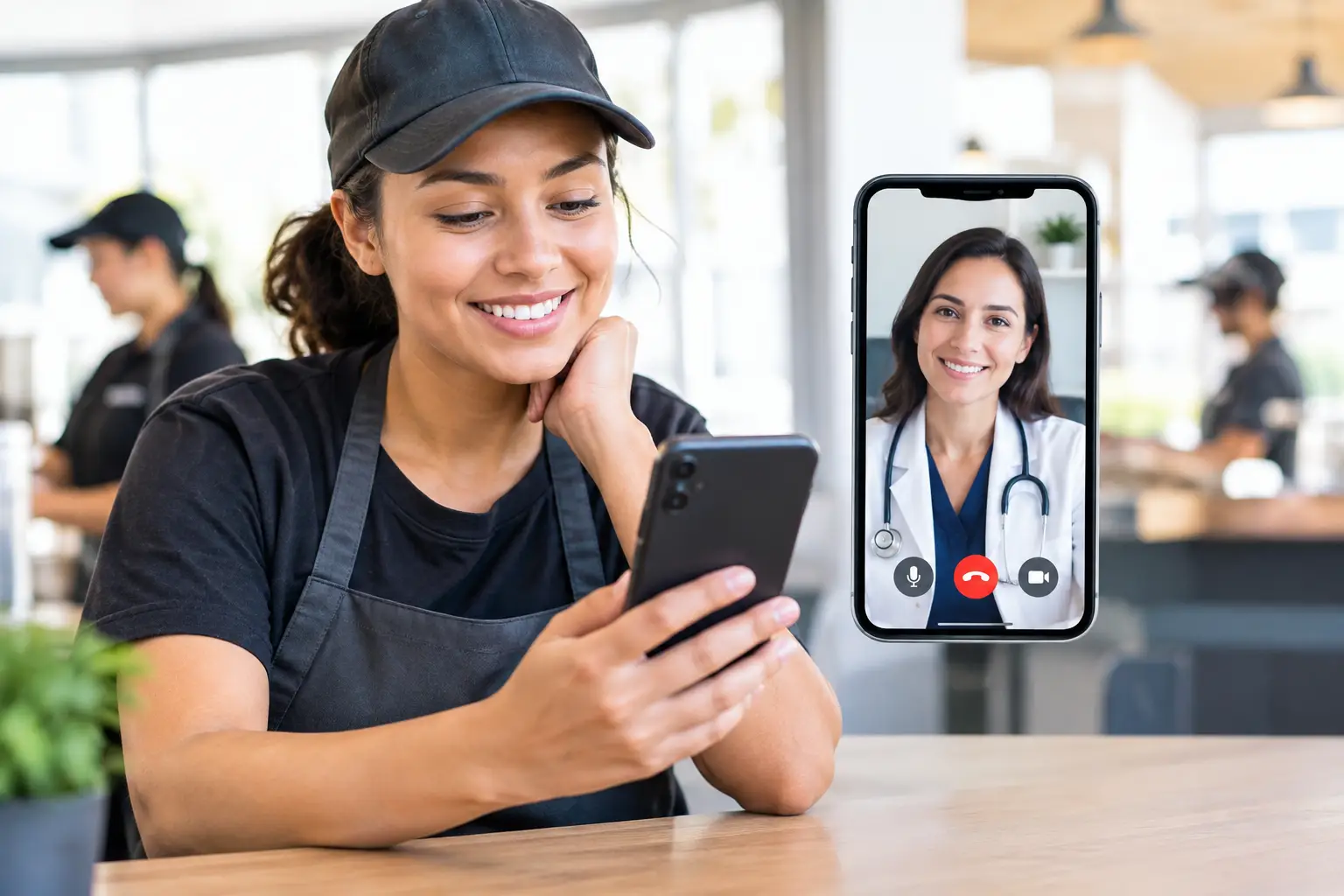
Saturday dinner service rarely exposes a restaurant’s benefit design. The line is moving, the dining room is full, and the people keeping both on track may include college students, parents working around school schedules, second-job employees, and team members whose hours change week to week. Yet those same realities determine who typically receives employer health coverage and who is left to sort out care alone.
That is the central question behind **healthcare for part-time employees**. It is not whether a restaurant operator can replicate a traditional full-time benefits package for every role. For many multi-unit businesses, that remains economically impractical. The more useful question is whether the company can extend meaningful healthcare access to a much broader share of its workforce at a cost that fits the operating model.
For years, the choice was often binary: offer conventional insurance where eligibility and economics allow, or offer little healthcare support at all. That choice is beginning to change. The distinction matters because part-time work is not peripheral to restaurant operations. It is often how the operation meets demand, covers peaks, and gives employees flexibility.
## The part-time employment value gap
A full-time offer has traditionally carried value beyond wages: predictable hours, paid time off, and employer-sponsored health coverage where available. Part-time roles may offer flexibility and a way into the business, but the healthcare component has usually been absent. That creates a gap between the work employers need and the employment offer they can reasonably afford to make.
The gap is not necessarily the result of indifference. Traditional health insurance was designed around eligibility rules, enrollment periods, participation requirements, and premiums that can be difficult to justify for variable-hour populations. A restaurant group with a stable salaried leadership team and a fluctuating hourly workforce faces two very different benefits problems. Treating them as one often produces either an unworkable cost structure or a narrow offer that leaves most employees outside it.
Employees still have healthcare needs regardless of their scheduled hours. A [prescription needs filling](https://ful-health.com/blog/healthcare-guides/how-to-find-cheap-prescriptions-near-me-today). A child develops an ear infection. Someone receives a [hospital bill they do not understand](https://ful-health.com/blog/healthcare-guides/how-to-read-hospital-bills). Someone else may qualify for public coverage but does not know where to start. These are ordinary situations, not exceptional ones, and they can be expensive in money, time, and attention.
For an employer, this does not mean every healthcare issue becomes a company responsibility. It does mean the historic boundary between benefits-eligible and benefits-ineligible workers deserves another look. If a practical level of access can be extended broadly, the value proposition of a part-time role may be stronger than it was when insurance was the only meaningful healthcare option.
## Why insurance is not the only decision
Conventional group health insurance remains a valuable benefit for many full-time employees. Nothing about a lower-cost healthcare access model changes that. The mistake is assuming insurance is the only category through which an employer can help workers engage with healthcare.
Healthcare access can include a physician when one is needed, help identifying lower-cost prescriptions, assistance understanding a bill, guidance through available care options, and [support applying for public programs](https://ful-health.com/blog/healthcare-guides/chip-enrollment-help-for-parents) when eligible. These services do not replace major medical coverage, and employers should be precise about that distinction. They can, however, address practical barriers that insurance alone does not always solve, particularly for people without coverage or with coverage they struggle to use.
This is a different economic choice. Rather than asking whether every part-time employee can be added to an insurance plan, an operator can ask what meaningful access is worth if it can be offered at a predictable monthly cost and without insurance-level administration.
Ful.Health, for example, is a healthcare access platform rather than health insurance. Starting at $8.95 per employee per month, it combines unlimited $0 physician access with prescription savings, hospital-bill support, public-program enrollment assistance, healthcare guidance, and household access. Whether that specific model fits a company is a decision for its leaders, but the broader point is more durable: healthcare support no longer has to be all-or-nothing.
## What a restaurant operator should evaluate
The financial conversation should begin with the workforce an operator is actually trying to support. That population may include hourly staff consistently below full-time eligibility thresholds, seasonal hires, employees with highly variable schedules, or workers who decline traditional coverage because of cost or household circumstances. They are not interchangeable groups, and a useful analysis separates them.
Start with the number of employees who are regularly outside the company’s existing health plan. Then consider a per-employee monthly investment against the annual cost of that population. The result is not a promised return calculation. It is the cost of making a more substantive healthcare offer to people who may currently receive none.
The next question is what employees would actually receive. A solution that sounds broad but requires complicated enrollment, excludes household members, or offers only a narrow point service may have less practical value than its description suggests. Conversely, a simple offering can be valuable if it helps with common moments of friction: accessing a clinician, reducing prescription costs, understanding a bill, or finding coverage support.
Implementation deserves equal attention. Restaurant organizations have limited patience for programs that require managers to become benefits specialists or that add another process at the store level. Review how eligibility is determined, whether enrollment is available throughout the year, what information payroll or HR must provide, how employees get help, and whether communications can work for people who do not sit at a desk. Low administrative burden is not a convenience feature. It affects whether a program will be executed consistently across locations.
Finally, be clear about the objective. Some companies will view healthcare access primarily as a way to improve the quality of their employment offer. Others may be looking for a more credible recruiting message in a market where applicants compare more than hourly pay. Some may believe it could support retention or reduce the disruption that follows when employees face unresolved healthcare problems. Those outcomes are possible, but they are not guaranteed, and they should not be the only basis for the decision.
## The trade-offs are real
Broadening healthcare access will not solve every labor challenge in a restaurant business. It cannot compensate for an uncompetitive wage, inconsistent scheduling, weak unit leadership, or an operation that makes it hard for good people to succeed. Nor will every employee use a healthcare access benefit in the same way. Some will see immediate value; others may not need it in a given year.
That does not make the investment less rational. Many parts of an employment offer are valued differently by different employees. The relevant standard is whether the program provides credible, understandable support to a population that has historically had limited options through work.
There is also a communication trade-off. Employers should avoid presenting an access platform as insurance or implying that it eliminates employees’ healthcare costs. Precision builds trust. Employees can understand the difference between major medical coverage and practical help using the healthcare system, especially when the explanation focuses on what they can do with the benefit rather than on broad promises.
## A better way to frame the investment
The most useful framing is not, “Will this fix turnover?” It is, “Can we make healthcare meaningfully more accessible to the people who make our restaurants run, at a cost we can sustain?” That question is more honest, more measurable, and closer to the decision in front of an operator.
A company may decide the answer is no because margins, workforce mix, or competing priorities do not support the investment. That is a valid conclusion. But the decision should reflect the current range of choices, not an outdated assumption that traditional insurance is the only way to provide healthcare-related value.
Part-time employment has always been essential to the restaurant model. The opportunity now is to reconsider whether part-time employees must also remain outside meaningful healthcare support. For many operators, that is no longer a question of intent. It is a question of economics, design, and whether the business is ready to close a gap it has long had to accept.
## Keep Reading
[](https://ful-health.com/blog/workforce-insights/frontline-healthcare-restaurant-business-choice)
### [Frontline Healthcare Is a Restaurant Business Choice](https://ful-health.com/blog/workforce-insights/frontline-healthcare-restaurant-business-choice)
A restaurant can post a competitive hourly rate, offer shift flexibility, feed people on the clock,...
[](https://ful-health.com/blog/workforce-insights/what-employee-healthcare-platforms-change)
### [What Employee Healthcare Platforms Change](https://ful-health.com/blog/workforce-insights/what-employee-healthcare-platforms-change)
A restaurant can be fully staffed on the schedule and still be carrying more uncertainty than the...
[](https://ful-health.com/blog/workforce-insights/health-insurance-alternatives-for-employees)
### [Health Insurance Alternatives for Employees](https://ful-health.com/blog/workforce-insights/health-insurance-alternatives-for-employees)
The hiring conversation at a restaurant often reaches the same hard edge: the candidate wants to...
Ready to talk?
[Schedule a Conversation →](https://landing.ful-health.com/schedule-a-conversation)
[Contact](https://ful-health.com/contact-us)
©2026 ful.Health LLC All rights reserved.
[Privacy Policy](https://ful-health.com/legal/privacy-policy) [Terms of Service](https://ful-health.com/legal/terms-of-service)
```json
{
"@context" : "https://schema.org",
"@type" : "BlogPosting",
"author" : {
"@type" : "Person",
"name" : "Carrie Tedore",
"url" : "https://ful-health.com/blog/workforce-insights/author/carrie-tedore"
},
"datePublished" : "2026-09-09T02:16:05.000Z",
"headline" : "Healthcare for Part-Time Employees Can Be Practical",
"image" : [ "https://afocirmbqdxnkyescnev.supabase.co/storage/v1/object/public/featured-images/890b153f-86f0-41a5-98f8-a16f8ab177a6/workflows/a6b55847-7ff3-4d45-a357-7ee206109c0b.webp" ],
"mainEntityOfPage" : {
"@id" : "https://ful-health.com/blog/workforce-insights/healthcare-for-part-time-employees",
"@type" : "WebPage"
},
"publisher" : {
"@type" : "Organization",
"logo" : {
"@type" : "ImageObject",
"url" : "https://ful-health.com/hubfs/ful%20logo_full%20color_RGB.png"
},
"name" : "ful.Health LLC"
}
}
```