---
title: How Hotels Offer Employee Healthcare Today
description: See how hotels offer employee healthcare beyond traditional insurance, with practical options for part-time, seasonal, and frontline teams and families.
image: https://afocirmbqdxnkyescnev.supabase.co/storage/v1/object/public/featured-images/890b153f-86f0-41a5-98f8-a16f8ab177a6/workflows/9bf2a133-612a-40ce-9d07-d67a240f072e.webp
---
- [For Employers](https://ful-health.com/for-employers)
- [Overview](https://ful-health.com/for-employers)
- [Business Case](https://ful-health.com/be/the-business-case)
- [What FUL Includes](https://ful-health.com/be/consider-ful)
- [Resources](https://ful-health.com/resource-center)
- [About Us](https://ful-health.com/about-us)
- Blog
- [Workforce Insights](https://ful-health.com/blog/workforce-insights)
- [Healthcare Guides](https://ful-health.com/blog/healthcare-guides)
- [Employer Resources](https://ful-health.com/resource-center)
[Schedule a Conversation](https://landing.ful-health.com/schedule-a-conversation)
[](https://apps.apple.com/us/app/ful-cashpay-health-savings/id6742342974) [](https://play.google.com/store/apps/details?id=com.ful.cashpay)
## Get FUL on your phone
Scan with your phone's camera and we'll take you to the right app store.

Or download it directly
[](https://apps.apple.com/us/app/ful-cashpay-health-savings/id6742342974) [](https://play.google.com/store/apps/details?id=com.ful.cashpay)
# How Hotels Offer Employee Healthcare Today
[Carrie Tedore](https://ful-health.com/blog/workforce-insights/author/carrie-tedore) · November 2, 2026
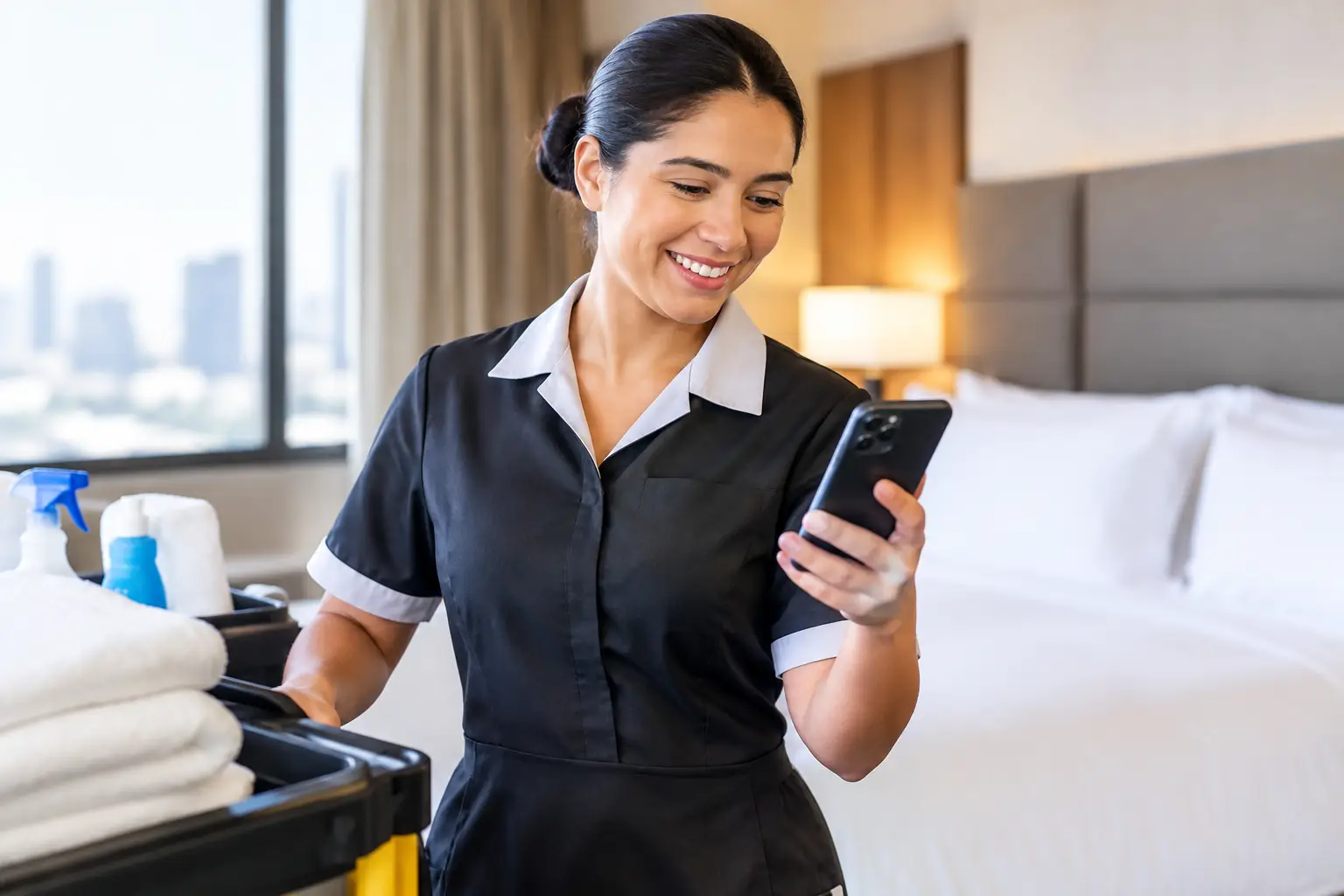
A hotel can have a polished benefits package on paper and still leave much of the workforce outside it. The front desk agent working variable shifts, the banquet server called in for events, the housekeeper with a part-time schedule, and the seasonal pool team may all be essential to the guest experience while remaining ineligible for the employer-sponsored coverage offered to full-time staff.
That is the operating reality behind the question of **how hotels offer employee healthcare**. It is not simply a benefits-design question. It is a question of whether the employment offer reflects the workforce a hotel actually relies on - including the people whose schedules, hours, and tenure do not fit conventional insurance eligibility rules.
## Why traditional coverage leaves a gap
For many hotels, traditional group health insurance remains an appropriate and valuable benefit for employees who meet full-time eligibility requirements. It is familiar, comprehensive, and often central to the employment proposition for managers and long-tenured team members.
The difficulty is that hotel staffing rarely divides cleanly into full-time employees who matter and everyone else who does not. Hospitality depends on a blend of full-time, part-time, on-call, seasonal, and variable-hour roles. Demand shifts with occupancy, conventions, weddings, holidays, weather, and local events. A property may need more people on Friday and Saturday than it needs on Tuesday afternoon, and its staffing model has to accommodate that reality.
Traditional insurance was not designed around that variability. Eligibility rules, administrative requirements, and premium costs can make it impractical to extend the same coverage to every hourly employee. This does not mean those employees have no healthcare needs. It means the employer has historically faced an unappealing choice: provide insurance-level coverage at insurance-level cost, or leave employees to sort out care, prescriptions, bills, and coverage options on their own.
That binary choice is becoming less necessary.
## How hotels offer employee healthcare beyond insurance
Hotels are increasingly separating two ideas that have long been treated as inseparable: health insurance and meaningful access to healthcare. Insurance remains one way to support employees, particularly those eligible for a conventional plan. But it is not the only way to make care more accessible for workers who are excluded from, cannot afford, or do not enroll in traditional coverage.
A practical healthcare-access offering can give eligible employees and, in some cases, their households a place to start when they need help. Depending on the program, that may include no-cost physician access, prescription savings, help understanding public coverage options, guidance through healthcare decisions, and support when a hospital bill becomes difficult to interpret or manage.
Those services do not replace major medical insurance. They should not be presented that way. A virtual physician visit cannot substitute for comprehensive coverage after a serious accident, surgery, or complex diagnosis. But that distinction should not obscure the value of making routine care and trusted guidance available to employees who otherwise may have little support.
For an hourly hotel employee, the immediate question is often not whether a benefit has the same actuarial value as an insurance plan. It is more basic: Can I speak to a clinician without taking on an uncertain bill? Can I afford a prescription? Is there someone who can explain what this notice means? Does my household have any help when a healthcare issue arises?
A hotel that can answer those questions more often is offering something materially different from a discount brochure or an unused portal.
## The employment value gap is often hiding in plain sight
Hotel leaders already think carefully about the difference between a job that fills shifts and an employment offer that attracts people back. Pay is central, as it should be. Schedule predictability, working conditions, advancement, and management quality also matter. Healthcare access belongs in that conversation because the gap is so visible between employees who receive traditional benefits and those who do not.
This is the [part-time employment](https://ful-health.com/blog/healthcare-guides/affordable-healthcare-for-part-time-workers) value gap. Two employees may work side by side during a sold-out weekend, but one has access to employer-supported healthcare and the other may be navigating care alone because of status or hours. The difference is not necessarily the result of indifference. It often follows from the economics and rules of conventional benefits.
Still, employees experience the difference personally. A hotel does not need to promise that healthcare access will solve retention or eliminate attendance challenges to recognize that a more complete employment offer may be noticed and valued. The appropriate business case is more measured: if a relatively modest investment helps make work at the property a more viable choice for more people, it deserves examination alongside other labor investments.
## What to evaluate before choosing an approach
The first question is not which vendor has the longest feature list. It is which employee population the hotel intends to serve and what problem it is trying to address.
A limited-service property with a largely stable, full-time team may reach a different conclusion than a resort with pronounced seasonality, a convention hotel with substantial banquet staffing, or a management company overseeing properties with very different labor models. The workforce mix should shape the decision.
Leadership teams should also examine whether the offering is understandable at the moment an employee needs it. Healthcare programs can look compelling during enrollment and still be difficult to use in real life. If an employee has a sick child at night, needs a [lower-cost prescription](https://ful-health.com/blog/healthcare-guides/how-to-find-cheap-prescriptions-near-me-today), or receives an unfamiliar medical bill, the path to help should be clear. A benefit that requires employees to decode several separate programs may have less practical value than its brochure suggests.
Household access is another meaningful design choice. Healthcare decisions rarely stay within the boundaries of an employee record. When a spouse, child, or dependent needs help, that affects the employee's finances, time, and attention as well. An employer does not have to assume responsibility for every household healthcare need, but it should be clear about whether its offering recognizes that reality.
Finally, finance leaders should distinguish predictable access costs from [claims risk](https://ful-health.com/blog/healthcare-guides/high-deductible-versus-uninsured). Traditional health insurance carries its own structure of premiums, plan design, compliance obligations, and administration. A healthcare-access platform may be priced on a simpler per-employee basis, allowing an employer to extend support more broadly without representing it as insurance. That makes comparison possible, but not simplistic: the two offerings solve different problems and may work together rather than compete.
## A practical model for hospitality operators
The strongest approach is often layered. Maintain traditional insurance where it makes sense for eligible full-time employees, then consider an accessible healthcare program for the broader hourly and variable-hour population. The point is not to create tiers of care or present a lower-cost option as equivalent coverage. It is to reduce the number of employees for whom the company offers no meaningful path to care at all.
Implementation matters as much as design. Hotel workforces can include multiple languages, varied digital access, irregular schedules, and employees who do not spend their days at a desk. Communication should be plain, repeated, and available through the channels employees actually use. Managers should understand enough to direct people to the resource, without being put in the position of giving healthcare advice.
It is also sensible to set modest expectations. Track enrollment and utilization where appropriate, listen for recurring employee questions, and assess whether the program reaches the intended population. Avoid assigning outcomes the evidence cannot support. A healthcare-access offering may contribute to a stronger employment proposition, but its value should be judged over time alongside the hotel’s broader labor and operating context.
Programs such as Ful.Health illustrate the changed economics: beginning at $8.95 per eligible employee per month, employers can provide unlimited $0 physician access, prescription savings, coverage support, hospital-bill assistance, healthcare guidance, and household access without positioning the offering as health insurance.
The useful shift for hotel leaders is straightforward. The decision is no longer limited to buying traditional insurance for everyone or offering nothing meaningful to workers outside the plan. Healthcare access can now be considered as its own investment - one that acknowledges how modern hotel teams are staffed and what employees may need when life happens away from the property.
Ready to talk?
[Schedule a Conversation →](https://landing.ful-health.com/schedule-a-conversation)
[Contact](https://ful-health.com/contact-us)
©2026 ful.Health LLC All rights reserved.
[Privacy Policy](https://ful-health.com/legal/privacy-policy) [Terms of Service](https://ful-health.com/legal/terms-of-service)
```json
{
"@context" : "https://schema.org",
"@type" : "BlogPosting",
"author" : {
"@type" : "Person",
"name" : "Carrie Tedore",
"url" : "https://ful-health.com/blog/workforce-insights/author/carrie-tedore"
},
"datePublished" : "2026-11-02T03:51:11.000Z",
"headline" : "How Hotels Offer Employee Healthcare Today",
"image" : [ "https://afocirmbqdxnkyescnev.supabase.co/storage/v1/object/public/featured-images/890b153f-86f0-41a5-98f8-a16f8ab177a6/workflows/9bf2a133-612a-40ce-9d07-d67a240f072e.webp" ],
"mainEntityOfPage" : {
"@id" : "https://ful-health.com/blog/workforce-insights/how-hotels-offer-employee-healthcare",
"@type" : "WebPage"
},
"publisher" : {
"@type" : "Organization",
"logo" : {
"@type" : "ImageObject",
"url" : "https://ful-health.com/hubfs/ful%20logo_full%20color_RGB.png"
},
"name" : "ful.Health LLC"
}
}
```