---
title: How to Support Distributed Employees Across Shifts
description: Learn how to support distributed employees with clear communication and healthcare access across local restaurant locations, shifts, and employment types.
image: https://afocirmbqdxnkyescnev.supabase.co/storage/v1/object/public/featured-images/890b153f-86f0-41a5-98f8-a16f8ab177a6/workflows/40c7d93b-38fb-4227-b151-db7811980a01.webp
---
- [For Employers](https://ful-health.com/for-employers)
- [Overview](https://ful-health.com/for-employers)
- [Business Case](https://ful-health.com/be/the-business-case)
- [What FUL Includes](https://ful-health.com/be/consider-ful)
- [Resources](https://ful-health.com/resource-center)
- [About Us](https://ful-health.com/about-us)
- Blog
- [Workforce Insights](https://ful-health.com/blog/workforce-insights)
- [Healthcare Guides](https://ful-health.com/blog/healthcare-guides)
- [Employer Resources](https://ful-health.com/resource-center)
[Schedule a Conversation](https://landing.ful-health.com/schedule-a-conversation)
- [For Employers](https://ful-health.com/for-employers)
- [Overview](https://ful-health.com/for-employers)
- [Business Case](https://ful-health.com/be/the-business-case)
- [What FUL Includes](https://ful-health.com/be/consider-ful)
- [Resources](https://ful-health.com/resource-center)
- [About Us](https://ful-health.com/about-us)
- Blog
- [Workforce Insights](https://ful-health.com/blog/workforce-insights)
- [Healthcare Guides](https://ful-health.com/blog/healthcare-guides)
- [Employer Resources](https://ful-health.com/resource-center)
[Schedule a Conversation](https://landing.ful-health.com/schedule-a-conversation)
[](https://apps.apple.com/us/app/ful-cashpay-health-savings/id6742342974) [](https://play.google.com/store/apps/details?id=com.ful.cashpay)
## Get FUL on your phone
Scan with your phone's camera and we'll take you to the right app store.

Or download it directly
[](https://apps.apple.com/us/app/ful-cashpay-health-savings/id6742342974) [](https://play.google.com/store/apps/details?id=com.ful.cashpay)
# How to Support Distributed Employees Across Shifts
[Carrie Tedore](https://ful-health.com/blog/workforce-insights/author/carrie-tedore) · September 10, 2026
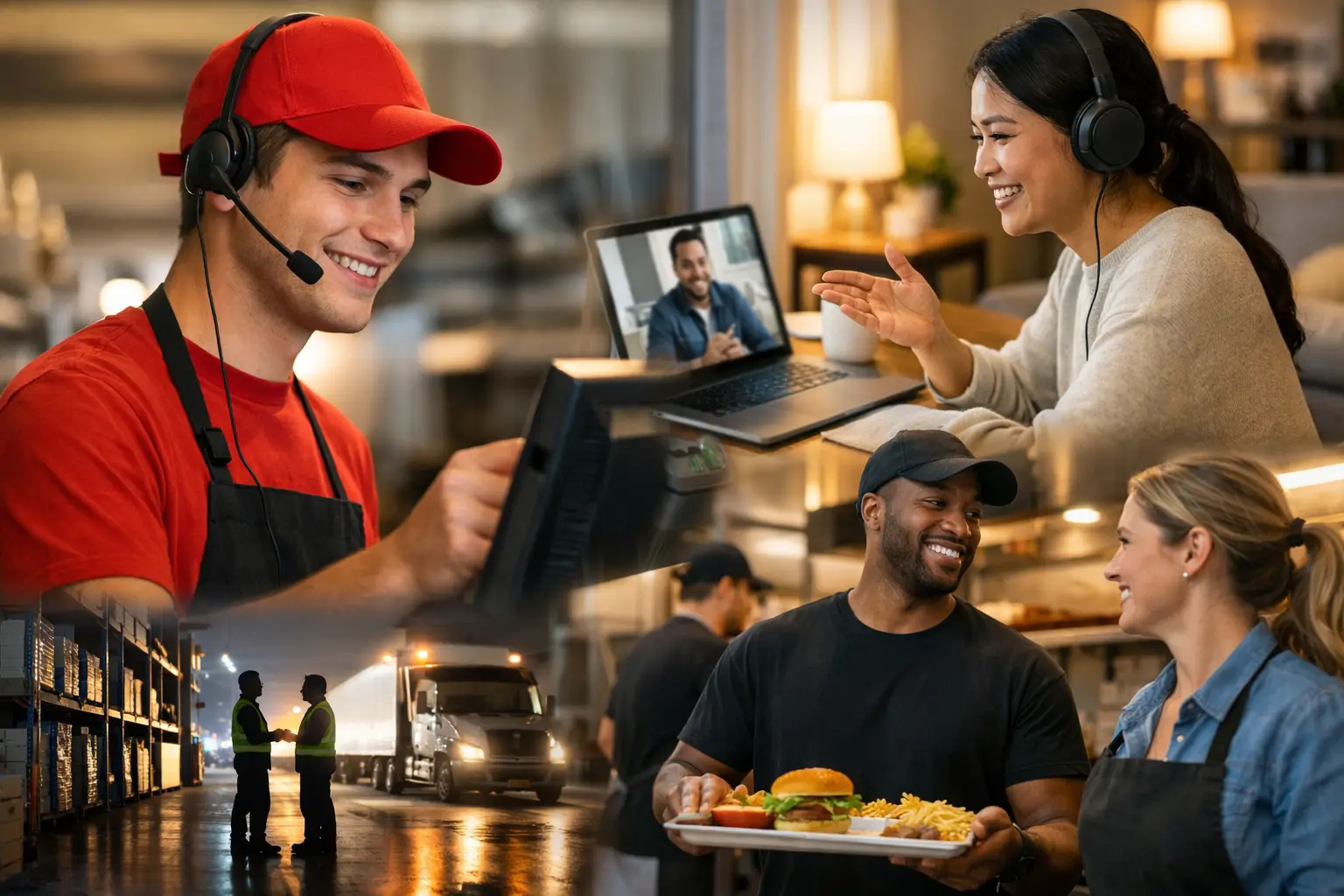
A restaurant can be running a strong lunch service in one location while another is short a line cook, a third is training new servers, and several employees are trying to get answers from home between shifts. From the executive office, the business may appear to have one workforce. In practice, it has dozens of smaller employee experiences shaped by store, manager, schedule, commute, tenure, and employment status.
That is the practical challenge behind **how to support distributed employees**. The question is not whether every location should operate identically. They should not. The question is whether employees in different places and on different schedules can reliably access the information and support the company intends to provide.
For restaurant operators, that distinction matters. A policy that exists in a handbook but cannot be understood on a phone after a late shift is not fully available. A healthcare offering limited to a narrow segment of the workforce may be financially familiar, but it can leave the people filling variable shifts with little help when they need care.
## Distributed work is often fragmented work
Restaurant work has always been distributed by nature. Employees are spread across locations, dayparts, roles, and changing schedules. Many do not sit at a computer, use a company email address regularly, or overlap with an HR team during normal business hours. [Part-time and variable-hour employees](https://ful-health.com/blog/healthcare-guides/affordable-healthcare-for-part-time-workers) may also move between locations or change availability as school, family obligations, or a second job changes.
This does not mean a multi-unit operator needs a more elaborate employee program. Complexity is usually part of the problem. It means support has to be designed around the way work actually happens.
A useful test is simple: if an employee needs help at 9:30 p.m. after a closing shift, can they find a clear next step without asking a manager to interpret a policy? If the answer is no, the organization may have support available in theory but not in a form that travels well across the operation.
The cost of that gap is not always visible in a monthly report. Managers spend time answering questions they were not hired to answer. Employees make decisions with incomplete information. Some delay care or [prescription refills](https://ful-health.com/blog/healthcare-guides/best-prescription-cash-discount-for-lower-costs) because the process feels costly or uncertain. None of these outcomes can be assigned neatly to one line item, but they affect the quality of the employment offer employees experience.
## How to support distributed employees without building another layer
The most effective approach is usually less about adding programs and more about making a few important forms of support easier to find, understand, and use. For a restaurant group, that begins with identifying the moments when employees actually need help: when they are hired, when their schedule changes, when they face a health concern, when they need medication, or when an unexpected bill arrives.
### Build for phones, shifts, and real questions
For frontline teams, communication that assumes a desk and a predictable workday will miss people. Mobile access is necessary, but it is not sufficient. The information itself needs to be plain enough that an employee can act on it quickly.
That means using the same short explanation across orientation, manager talking points, printed materials, and employee messages. It also means being honest about eligibility. Employees can handle a program with boundaries. What creates frustration is ambiguity about who qualifies, what the program does, and where to go for help.
A regional restaurant operator may have different local practices, wage structures, and staffing patterns across markets. The core message does not need to change with every location. But the delivery may. One group may respond best to a QR code in the break room; another may need a brief explanation during pre-shift meetings because employees have limited time to review materials on their own.
### Give managers a path, not a script
Store managers are an essential channel, but they should not become the help desk for personal healthcare questions, benefits eligibility, or financial hardship. Their role is better defined as helping an employee reach the right resource.
This is an important trade-off. Asking managers to promote every company initiative can weaken adoption because the message competes with food safety, staffing, service standards, inventory, and the immediate demands of a shift. Asking them to remember too little can make an otherwise useful program invisible.
The middle ground is a short, repeatable manager path: what the offering is, who can use it, how an employee accesses it, and where more detailed questions go. If that cannot be explained clearly in a few sentences, it may be too difficult to operate consistently across a distributed organization.
### Measure access before promising outcomes
Executives naturally want to know whether an investment changes retention, attendance, recruiting, or productivity. Those are reasonable business questions. They are also difficult to answer cleanly in restaurants, where seasonality, location-level management, labor markets, and wage changes all influence workforce outcomes.
Start with evidence closer to the investment. Are eligible employees enrolling or activating access? Do they understand what is available? Are they using care, savings, coverage support, or guidance when a need arises? Are managers seeing fewer recurring questions because employees have a reliable place to go?
These measures do not prove a healthcare program caused a financial result. They do show whether the company has delivered something employees can realistically use. That is a more credible starting point than attaching a precise turnover claim to a benefit that employees may not yet know exists.
## Healthcare is where the employment value gap is most visible
Many restaurant companies already provide traditional medical insurance to employees who meet full-time eligibility requirements. For that group, the economics and administrative model are familiar. The harder question concerns the much larger group that may work part-time, variable hours, seasonal schedules, or frontline roles that do not fit conventional eligibility rules.
Historically, the choice could feel binary: offer insurance-level coverage at insurance-level cost and complexity, or leave employees to navigate care on their own. That framing no longer reflects all of the options available.
Practical healthcare access can now be offered separately from traditional insurance. The distinction matters. Employees may need timely physician access, help finding lower-cost prescriptions, assistance understanding public coverage options, support with a [hospital bill](https://ful-health.com/blog/healthcare-guides/hospital-financial-assistance-guide), or guidance from someone who can help them sort through a confusing healthcare decision. Their household may need support too. Those needs do not disappear because an employee works 25 hours one week and 35 the next.
For an operator, this is not an argument that every employee should receive the same healthcare arrangement. Traditional insurance remains appropriate for many eligible full-time employees, and employers should be precise about what any program does and does not provide. It is an argument for reconsidering the blank space between full medical insurance and no meaningful support at all.
Ful.Health is one example of this newer economic choice. It is a healthcare access platform, not health insurance, designed to provide eligible employees and their households with unlimited $0 physician access, prescription savings, public-program enrollment assistance, hospital-bill support, and healthcare guidance. Starting at $8.95 per employee per month, it gives employers a way to extend practical support without the cost structure or open-enrollment constraints of traditional insurance.
Whether that model fits a particular restaurant group depends on its workforce mix, current benefits, local labor conditions, and financial priorities. But the strategic question is worth asking: What does the company’s employment offer communicate to the employees it depends on but has historically found hardest to cover?
## Make the decision at the operating level
The right evaluation is not simply whether a program has an attractive per-employee price. It is whether it can be implemented with enough clarity that employees use it and managers can support it without additional friction.
A CFO may begin with eligible headcount, monthly cost, and budget predictability. A COO may focus on whether the program works across locations and shifts without creating another administrative burden. A CEO may ask whether it strengthens the company’s ability to compete for employees without making promises the operation cannot sustain. All three are asking versions of the same question: is this support real in the employee’s daily life?
Before moving forward, operators should test the practical details. Who is eligible? Can a new hire understand the offering during onboarding? Can employees access it outside business hours? Does it include household access where that matters? Is there a clear escalation path for questions that should not land with a shift manager? And can the company describe the program accurately without implying it is insurance when it is not?
The most useful employee support is rarely the loudest. It is the kind that is available at the moment an employee needs it, understandable without a manager translating it, and broad enough to reach people who have long been outside the usual benefits model. For distributed restaurant teams, that may be the difference between offering a benefit on paper and extending meaningful healthcare access in practice.
## Keep Reading
[](https://ful-health.com/blog/workforce-insights/healthcare-for-hourly-employees-restaurant-decision)
### [Healthcare for Hourly Employees Is a Restaurant Decision](https://ful-health.com/blog/workforce-insights/healthcare-for-hourly-employees-restaurant-decision)
A restaurant can run a sharp service with a workforce that is constantly making difficult tradeoffs...
[](https://ful-health.com/blog/workforce-insights/multi-location-workforce-planning-guide)
### [A Multi Location Workforce Planning Guide](https://ful-health.com/blog/workforce-insights/multi-location-workforce-planning-guide)
A restaurant can be fully staffed on a companywide report and still be short where it matters. One...
[](https://ful-health.com/blog/workforce-insights/warehouse-employee-care-access-business-decision)
### [Warehouse Employee Care Access Is a Business Decision](https://ful-health.com/blog/workforce-insights/warehouse-employee-care-access-business-decision)
A distribution center can be running on schedule while a large share of its people are carrying a...
Ready to talk?
[Schedule a Conversation →](https://landing.ful-health.com/schedule-a-conversation)
[Contact](https://ful-health.com/contact-us)
©2026 ful.Health LLC All rights reserved.
[Privacy Policy](https://ful-health.com/legal/privacy-policy) [Terms of Service](https://ful-health.com/legal/terms-of-service)
```json
{
"@context" : "https://schema.org",
"@type" : "BlogPosting",
"author" : {
"@type" : "Person",
"name" : "Carrie Tedore",
"url" : "https://ful-health.com/blog/workforce-insights/author/carrie-tedore"
},
"datePublished" : "2026-09-10T02:10:40.000Z",
"headline" : "How to Support Distributed Employees Across Shifts",
"image" : [ "https://afocirmbqdxnkyescnev.supabase.co/storage/v1/object/public/featured-images/890b153f-86f0-41a5-98f8-a16f8ab177a6/workflows/40c7d93b-38fb-4227-b151-db7811980a01.webp" ],
"mainEntityOfPage" : {
"@id" : "https://ful-health.com/blog/workforce-insights/how-to-support-distributed-employees",
"@type" : "WebPage"
},
"publisher" : {
"@type" : "Organization",
"logo" : {
"@type" : "ImageObject",
"url" : "https://ful-health.com/hubfs/ful%20logo_full%20color_RGB.png"
},
"name" : "ful.Health LLC"
}
}
```