---
title: Part Time Healthcare Access Is a Restaurant Decision
description: Part time healthcare access gives restaurant operators a way to extend meaningful support beyond full-time eligibility without insurance-level complexity.
image: https://afocirmbqdxnkyescnev.supabase.co/storage/v1/object/public/featured-images/890b153f-86f0-41a5-98f8-a16f8ab177a6/workflows/6759ab3e-628e-4361-82ef-2d5a040f77fd.webp
---
- [For Employers](https://ful-health.com/for-employers)
- [Overview](https://ful-health.com/for-employers)
- [Turnover Impact](https://ful-health.com/be/growth-capacity)
- [Business Case](https://ful-health.com/be/the-business-case)
- [What FUL Includes](https://ful-health.com/be/consider-ful)
- [Resources](https://ful-health.com/resource-center)
- [About Us](https://ful-health.com/about-us)
- Blog
- [Workforce Insights](https://ful-health.com/blog/workforce-insights)
- [Healthcare Guides](https://ful-health.com/blog/healthcare-guides)
- [Employer Resources](https://ful-health.com/resource-center)
[Schedule a Conversation](https://landing.ful-health.com/schedule-a-conversation)
- [For Employers](https://ful-health.com/for-employers)
- [Overview](https://ful-health.com/for-employers)
- [Turnover Impact](https://ful-health.com/be/growth-capacity)
- [Business Case](https://ful-health.com/be/the-business-case)
- [What FUL Includes](https://ful-health.com/be/consider-ful)
- [Resources](https://ful-health.com/resource-center)
- [About Us](https://ful-health.com/about-us)
- Blog
- [Workforce Insights](https://ful-health.com/blog/workforce-insights)
- [Healthcare Guides](https://ful-health.com/blog/healthcare-guides)
- [Employer Resources](https://ful-health.com/resource-center)
[Schedule a Conversation](https://landing.ful-health.com/schedule-a-conversation)
[](https://apps.apple.com/us/app/ful-cashpay-health-savings/id6742342974) [](https://play.google.com/store/apps/details?id=com.ful.cashpay)
## Get FUL on your phone
Scan with your phone's camera and we'll take you to the right app store.

Or download it directly
[](https://apps.apple.com/us/app/ful-cashpay-health-savings/id6742342974) [](https://play.google.com/store/apps/details?id=com.ful.cashpay)
# Part Time Healthcare Access Is a Restaurant Decision
[Carrie Tedore](https://ful-health.com/blog/workforce-insights/author/carrie-tedore) · September 28, 2026

A restaurant can have a carefully built benefits program and still leave much of its operating workforce outside it. The assistant manager may qualify. The line cook who works variable hours, the host building a second job around school, and the weekend server who has become indispensable may not.
That is not necessarily a failure of intent. It is how traditional health insurance was designed and priced. For many restaurant businesses, eligibility rules, participation requirements, administrative work, and premium costs make broad coverage impractical. The result is a familiar divide: healthcare is part of the value of a full-time role, while many part-time employees are left to sort out care, prescriptions, bills, and public-program eligibility on their own.
**Part time healthcare access** deserves consideration as a business decision because the old choice is no longer the only choice. Employers do not have to choose solely between insurance-level spending and offering nothing meaningful.
## The value gap is visible in ordinary restaurant work
Restaurant operators already make differentiated employment decisions every day. Roles carry different schedules, wage structures, training investments, responsibilities, and advancement paths. Not every difference is a problem. But healthcare can create a particularly sharp line because an employee's need for help does not begin when their schedule reaches a benefit threshold.
A worker with a child who needs a physician, a prescription that costs more than expected, or a confusing hospital bill has the same immediate problem whether they work 18 hours or 38. From the employee's perspective, eligibility rules can make the employment offer feel less complete than the work itself requires. From the operator's perspective, traditional insurance may still be an economically unsound answer for that population.
That mismatch is the part-time employment value gap. It is not an argument that every restaurant should provide the same benefits to every position. It is an argument that employees who have historically been difficult to cover may now be able to receive meaningful help without asking the employer to recreate a full insurance plan for each of them.
## Why insurance has not been a practical fit for every role
Traditional group health insurance is valuable, and for many full-time employees it remains central to a competitive employment offer. But it comes with economics and administration that are hard to separate from the product itself. Premiums are significant, eligibility and enrollment rules matter, and plan decisions often need to work across a broad population rather than around a variable-hour workforce.
Restaurants feel those constraints differently depending on concept, geography, seasonality, staffing model, and labor market. A multi-unit quick-service operator, a hotel restaurant, and an independent fine-dining group may reach different conclusions about who is eligible for insurance and why. That variation is reasonable.
The problem arises when the conclusion becomes binary: full traditional coverage for eligible employees or no employer-supported healthcare access for everyone else. A binary choice can persist simply because the alternatives have been thin, fragmented, or difficult to explain.
A practical access model changes the question. Rather than asking whether a part-time employee can be added to an insurance plan, leadership can ask what useful healthcare support can be extended at a cost the business can sustain across a larger share of its workforce.
## What meaningful access should actually mean
A low price alone does not make a healthcare offering valuable. Employees need help with the situations that create friction in real life, not another account they have to decipher during a busy week.
Meaningful access can include physician care without a visit charge, help finding and using appropriate care, prescription savings, assistance understanding [public coverage options](https://ful-health.com/blog/healthcare-guides/chip-enrollment-help-for-parents), and support when [hospital bills](https://ful-health.com/blog/healthcare-guides/hospital-financial-assistance-guide) become difficult to navigate. Household access matters as well. For many hourly employees, the health issue affecting work may involve a spouse, child, or parent rather than the employee alone.
This is not health insurance, and employers should be direct about that distinction. It will not replace comprehensive coverage, protect against every major medical expense, or make eligibility obligations disappear. It can, however, make a concrete difference between navigating healthcare alone and having a place to start.
That distinction is commercially important. Employees can recognize the difference between a superficial perk and a credible source of help. Overpromising damages trust. Clearly describing what is available, who can use it, and how it works gives the offering a better chance of becoming part of the employment value proposition.
## The financial question is broader than a premium comparison
A CFO evaluating a part-time healthcare access program should begin with unit economics: monthly cost per eligible employee, expected enrollment approach, household inclusion, implementation burden, and the degree to which pricing changes with headcount. Those are necessary questions.
They are not the only questions. The relevant comparison is not always the cost of a [limited-access program](https://ful-health.com/blog/healthcare-guides/affordable-healthcare-for-part-time-workers) versus a full medical plan. Often, it is the cost of extending no healthcare support to a substantial portion of the workforce versus making a modest, durable investment in that population.
The potential return is necessarily less precise than the monthly fee. An operator should not assume that healthcare access will produce a fixed reduction in turnover or absenteeism. Restaurants are affected by wages, scheduling, leadership, commute times, local competition, seasonality, and many other factors. No single offering controls those outcomes.
Still, employees evaluate the whole offer, especially when jobs look similar on pay and schedule. Healthcare support can be one of the few elements that signals a business has thought beyond the shift. That may influence recruiting conversations, an employee's willingness to stay, or the confidence with which a manager describes the job. Those are plausible business advantages, not guarantees.
The more useful discipline is to set a reasonable hypothesis in advance. For example: can this strengthen an employment offer at a cost low enough to extend broadly, while giving employees a service they can actually use? Then review participation, employee understanding, utilization signals where appropriate, recruiting feedback, and manager observations over time.
## Implementation determines whether employees experience the value
Restaurant operators have learned to be skeptical of programs that look good in a presentation and create confusion in the field. If access is hard to activate, communication relies on dense benefits language, or store leaders cannot answer basic questions, the investment may not translate into employee value.
The better approach is simple: define eligibility plainly, use direct language, and make enrollment and first use easy. Employees should understand that the program is healthcare access rather than insurance, what they can use immediately, and whether members of their household can participate. Managers do not need to become benefits counselors, but they should know where to send someone seeking help.
Timing also matters. A program that can be offered outside a traditional annual benefits cycle gives an operator flexibility. It can be introduced with a broader hiring initiative, after an acquisition, at the opening of a new market, or when leadership decides that existing eligibility rules no longer reflect the workforce it wants to build.
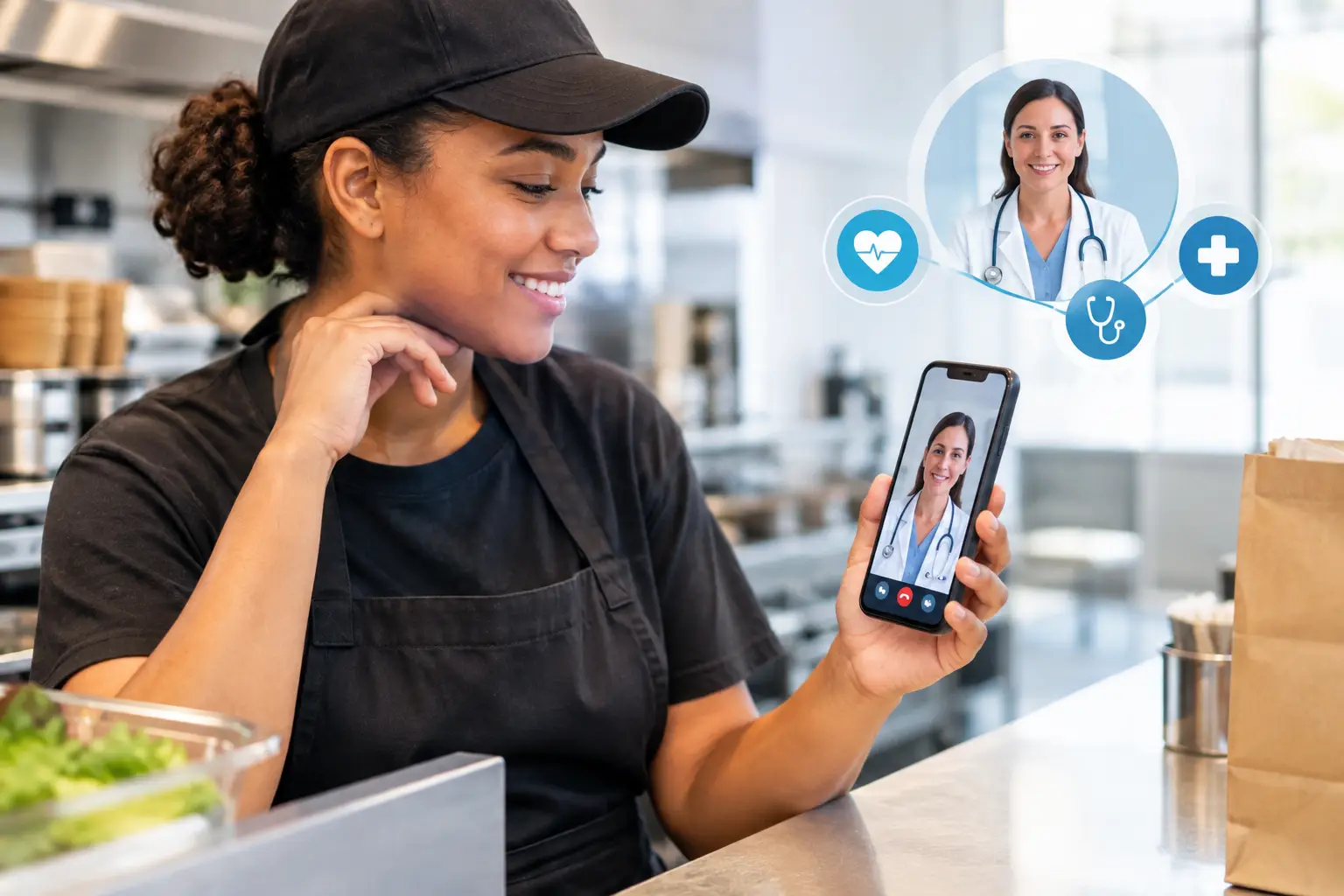
Ful.Health is one example of this newer category. Starting at $8.95 per employee per month, it combines unlimited $0 physician access with prescription savings, public-program enrollment assistance, hospital-bill support, healthcare guidance, and access for eligible employees' households. The point is not that every operator needs the same solution. It is that the economic category now exists: practical healthcare access without insurance-level cost and complexity.
## A decision worth separating from the insurance debate
Part-time healthcare access can get pulled into a familiar argument about whether benefits are affordable. That framing is too narrow. Traditional insurance may be the right answer for some employee groups and the wrong economic tool for others. Both can be true inside the same company.
The more useful question is whether the business can afford to leave a large portion of its essential workforce with no meaningful healthcare support simply because full insurance is not feasible for every role. For many restaurants, that is no longer the only available design.
The insight worth carrying forward is straightforward: healthcare access does not have to be reserved for the employees whose schedules happen to fit an old benefits model. A more practical level of support may be enough to close a gap employees feel clearly and leaders have long recognized.
## Keep Reading
[](https://ful-health.com/blog/workforce-insights/employee-support-programs-frontline-teams-value)
### [Employee Support Programs Frontline Teams Value](https://ful-health.com/blog/workforce-insights/employee-support-programs-frontline-teams-value)
A restaurant can have a strong brand, good food, and a disciplined operating model, yet still ask a...
[](https://ful-health.com/blog/workforce-insights/healthcare-access-strategy-restaurants)
### [A Healthcare Access Strategy for Restaurants](https://ful-health.com/blog/workforce-insights/healthcare-access-strategy-restaurants)
A restaurant can spend months refining its employment offer and still leave a large part of its...
[](https://ful-health.com/blog/workforce-insights/california-part-time-benefits-restaurant-view)
### [California Part Time Benefits: A Restaurant View](https://ful-health.com/blog/workforce-insights/california-part-time-benefits-restaurant-view)
A restaurant can have a dependable employee working four shifts a week, closing well, training new...
Ready to talk?
[Schedule a Conversation →](https://landing.ful-health.com/schedule-a-conversation)
[Contact](https://ful-health.com/contact-us)
©2026 ful.Health LLC All rights reserved.
[Privacy Policy](https://ful-health.com/legal/privacy-policy) [Terms of Service](https://ful-health.com/legal/terms-of-service)
```json
{
"@context" : "https://schema.org",
"@type" : "BlogPosting",
"author" : {
"@type" : "Person",
"name" : "Carrie Tedore",
"url" : "https://ful-health.com/blog/workforce-insights/author/carrie-tedore"
},
"datePublished" : "2026-09-28T02:32:25.000Z",
"headline" : "Part Time Healthcare Access Is a Restaurant Decision",
"image" : [ "https://afocirmbqdxnkyescnev.supabase.co/storage/v1/object/public/featured-images/890b153f-86f0-41a5-98f8-a16f8ab177a6/workflows/6759ab3e-628e-4361-82ef-2d5a040f77fd.webp" ],
"mainEntityOfPage" : {
"@id" : "https://ful-health.com/blog/workforce-insights/part-time-healthcare-access-restaurant-decision",
"@type" : "WebPage"
},
"publisher" : {
"@type" : "Organization",
"logo" : {
"@type" : "ImageObject",
"url" : "https://ful-health.com/hubfs/ful%20logo_full%20color_RGB.png"
},
"name" : "ful.Health LLC"
}
}
```