---
title: What Causes Staffing Gaps in Restaurants?
description: What causes staffing gaps in restaurants? See how demand, job design, scheduling, pay, and healthcare access shape reliable operating capacity each day.
image: https://afocirmbqdxnkyescnev.supabase.co/storage/v1/object/public/featured-images/3ddd0026-df42-4d18-ae09-5b880b20acd6/e400360e-80a3-47ef-9844-367f41a8b8c0.webp
---
- [For Employers](https://ful-health.com/for-employers)
- [Overview](https://ful-health.com/for-employers)
- [Business Case](https://ful-health.com/be/the-business-case)
- [What FUL Includes](https://ful-health.com/be/consider-ful)
- [Resources](https://ful-health.com/resource-center)
- [About Us](https://ful-health.com/about-us)
- Blog
- [Workforce Insights](https://ful-health.com/blog/workforce-insights)
- [Healthcare Guides](https://ful-health.com/blog/healthcare-guides)
- [Employer Resources](https://ful-health.com/resource-center)
[Schedule a Conversation](https://landing.ful-health.com/schedule-a-conversation)
- [For Employers](https://ful-health.com/for-employers)
- [Overview](https://ful-health.com/for-employers)
- [Business Case](https://ful-health.com/be/the-business-case)
- [What FUL Includes](https://ful-health.com/be/consider-ful)
- [Resources](https://ful-health.com/resource-center)
- [About Us](https://ful-health.com/about-us)
- Blog
- [Workforce Insights](https://ful-health.com/blog/workforce-insights)
- [Healthcare Guides](https://ful-health.com/blog/healthcare-guides)
- [Employer Resources](https://ful-health.com/resource-center)
[Schedule a Conversation](https://landing.ful-health.com/schedule-a-conversation)
[](https://apps.apple.com/us/app/ful-cashpay-health-savings/id6742342974) [](https://play.google.com/store/apps/details?id=com.ful.cashpay)
## Get FUL on your phone
Scan with your phone's camera and we'll take you to the right app store.

Or download it directly
[](https://apps.apple.com/us/app/ful-cashpay-health-savings/id6742342974) [](https://play.google.com/store/apps/details?id=com.ful.cashpay)
# What Causes Staffing Gaps in Restaurants?
[Carrie Tedore](https://ful-health.com/blog/workforce-insights/author/carrie-tedore) · August 27, 2026
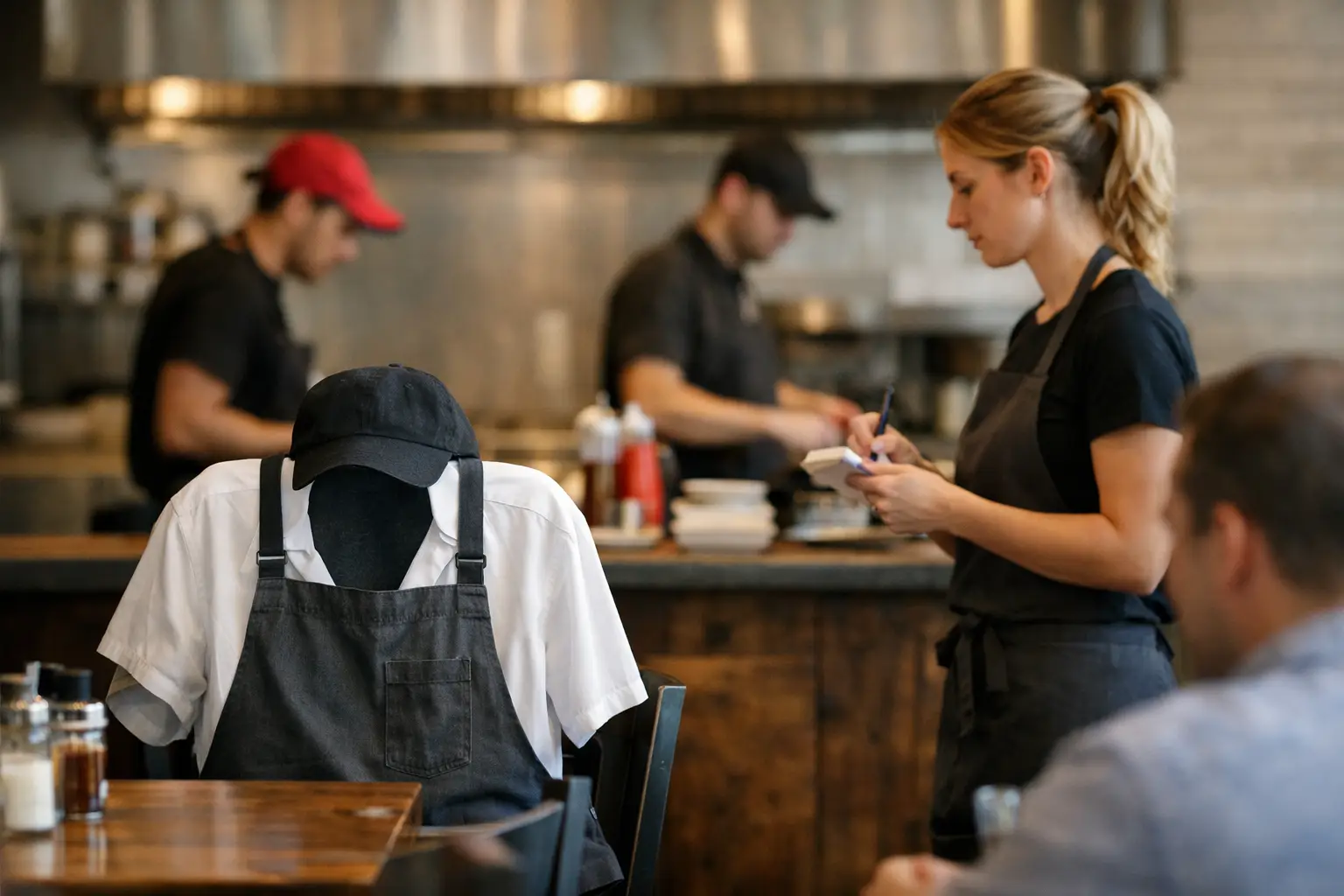
The gap usually becomes visible at 4:45 p.m., not in a staffing report. A dishwasher calls out. The delivery is late. The dining room is filling faster than forecast. A manager starts moving people between stations, and a shift that looked adequately staffed at noon suddenly is not.
That is why asking **what causes staffing gaps** is more useful than simply asking whether a restaurant is understaffed. Most operators already know their staffing level fluctuates. The harder question is why a labor plan that works on paper repeatedly falls short in the operating conditions that matter.
The answer is rarely one thing. Staffing gaps emerge where demand volatility, job design, labor-market conditions, and the employment proposition overlap. Some causes are inherent to the business. Others reflect choices that can be examined more closely. Separating the two helps leaders avoid treating every gap as a recruiting problem.
## What Causes Staffing Gaps Beyond Headcount
A staffing gap is not always an empty position. It can be a mismatch between the people scheduled and the work arriving. A restaurant may have its planned number of employees on the clock but still lack a grill cook during a late rush, a trained closer after a no-show, or enough prep coverage to recover from an unusually busy weekend.
This distinction matters financially. Headcount is easy to count. Productive coverage is what determines whether orders move, guests are served well, food quality holds, and managers can run the shift rather than fill every opening themselves.
### Demand changes faster than labor plans
Restaurants operate with a level of demand variation that few staffing models fully eliminate. Weather, local events, school calendars, promotions, delivery-platform volume, sporting events, road construction, and nearby competitors can all affect traffic. Even a well-built forecast is still a forecast.
The practical challenge is that labor supply cannot adjust with the same speed as demand. An extra table turn or unexpected catering order can be accommodated only if the schedule includes people with the availability and skills to respond. When that flexibility is thin, modest demand changes can create an outsized service problem.
This does not mean operators should overstaff every shift. Carrying excess labor is expensive, particularly in lower-margin concepts. It means labor planning needs to account for the cost of being precisely staffed in a business where demand is not precise.
### The available labor pool may not match the work
A restaurant may have applicants while still struggling to fill the shifts that matter most. The issue can be timing, transportation, required experience, physical demands, location, or the predictability of hours. A candidate who can work weekday mornings does not solve a Friday-night closing gap. A person who wants 35 hours may not be able to accept a variable schedule built around 18 to 24.
This is especially relevant where restaurants compete for the same workforce as retail, warehouses, healthcare support roles, hotels, and other local employers. The comparison employees make is not limited to hourly pay. They consider the full exchange: schedule, commute, workload, manager quality, growth prospects, and whether the employer offers anything useful beyond the paycheck.
For part-time and variable-hour employees, that last question has historically exposed a real limitation. Traditional employer-sponsored insurance often does not fit the economics or eligibility patterns of frontline restaurant work. As a result, many employees receive little employer-linked help with one of the most consequential costs and complications in their lives.
### Scheduling friction compounds quickly
Scheduling is where broader workforce constraints become visible. A schedule may be technically fair but operationally fragile if it depends on employees having unusually broad availability, reliable transportation, or the ability to absorb last-minute changes.
Restaurant operators also face a genuine trade-off. More stable schedules can make work easier to manage for employees, but rigid schedules can reduce a manager’s ability to respond to fluctuating demand. The right balance depends on the concept, hours of operation, seasonality, and how much cross-training exists in the team.
The question is not whether schedule changes can be eliminated. They cannot. The question is whether changes are communicated early, distributed reasonably, and supported by an employment proposition strong enough to remain competitive when workers have other options.
## The Less Visible Causes of Restaurant Staffing Gaps
Some staffing gaps are created before the schedule is posted. They begin with the structure and value of the work itself.
### Role design can create single points of failure
Many restaurants rely on a small number of people who know a station, a process, a supplier routine, or the unwritten details of a particular shift. That expertise is valuable. It also creates exposure when only one or two people can perform the work well.
Cross-training can reduce that exposure, but it has costs. Training takes manager time, productive hours, and patience during periods when the restaurant is already busy. Not every role can be interchangeable, and forcing interchangeability where it does not belong can hurt quality. Still, identifying the few roles where a single absence changes the whole shift is often more useful than making a broad commitment to cross-training.
A staffing gap, in other words, may be a capability gap rather than a numeric one.
### Compensation is necessary, but it is not the full equation
Pay matters. In a tight local labor market, an hourly rate that falls behind credible alternatives will narrow the candidate pool and weaken the restaurant’s employment proposition. But wage increases alone do not always solve coverage problems, particularly where employees face unpredictable hours or expenses that erase the practical value of a higher wage.
Restaurant leaders are right to scrutinize the return on every labor-dollar investment. The useful comparison is not simply wages versus benefits. It is whether the organization can create a more credible employment proposition for the workers it depends on without taking on the cost and administration of a traditional insurance plan that does not fit much of the workforce.
That is the part-time employment value gap. Full-time employment has long included healthcare as part of its value. Part-time, seasonal, hourly, and variable-hour workers have often been left to navigate care, prescriptions, coverage questions, and medical bills on their own.
### Healthcare changes the value calculation
Healthcare does not determine every employment decision. A family member may need care. A prescription may be unaffordable. A worker may receive a confusing hospital bill or not know whether they [qualify for Medicaid](https://ful-health.com/blog/healthcare-guides/medicaid-eligibility-help-online), CHIP, Medicare, or another public program. Whether those needs affect a particular employee’s job choice is personal and cannot be assumed.
The business question is more direct: does the job provide any meaningful help with healthcare, or does the employee remain entirely on their own?
For years, many restaurant employers had no economically practical answer for employees outside the traditional insurance-eligible population. The apparent choice was conventional insurance or little meaningful employer-linked healthcare access.
Ful.Health changes that choice. Starting at $8.95 per employee per month, Ful.Health gives employees and their households unlimited $0 physician access, prescription savings, public-program eligibility and enrollment assistance, hospital-bill support, healthcare guidance, and household access. It is a healthcare access platform, not health insurance, and it does not require insurance-level administration or an annual open-enrollment cycle.
For a restaurant operator, the point is not to treat healthcare access as a perk attached to a recruiting message. It is to consider whether giving part-time and frontline employees meaningful healthcare value makes the job more worth choosing—and whether that stronger employment proposition could be worth more to the business than it costs.
## How to Assess the Causes Without Oversimplifying Them
The most useful staffing review usually starts with operating patterns, not assumptions about employee motivation. Look at the shifts where service, speed, food quality, or manager workload deteriorate. Then ask what was actually missing: a person, a skill, availability, notice, or flexibility.
It also helps to compare gaps by daypart and role. If openings concentrate in closing shifts, the issue may be schedule fit or transportation rather than applicant volume. If gaps increase soon after hiring, the work or employment proposition may not be matching expectations. If a restaurant is fully staffed until one key employee is unavailable, role design may deserve more attention than recruiting spend.
Leaders should also resist importing a solution from one concept into another. A quick-service restaurant with a drive-thru has different pressure points from a full-service location dependent on servers and kitchen coordination. A seasonal resort restaurant may face a different labor market from an urban neighborhood concept. The common discipline is to identify the constraint before funding the response.
Staffing gaps ultimately reveal whether the organization has enough capable, available people to deliver the experience it promises when demand arrives. But identifying the operational gap is only part of the work. Leaders also need to examine whether the jobs themselves are competitive enough for the people the business depends on.
Not every staffing gap reflects a part-time employment value gap, and healthcare will not solve every labor constraint. But restaurants should no longer assume that meaningful healthcare is economically out of reach for part-time and frontline employees. That changed choice belongs in the analysis—especially when the business keeps spending money to recruit for jobs that remain difficult to choose.
## Keep Reading
[](https://ful-health.com/blog/workforce-insights/operating-capacity-definition-restaurant-leaders)
### [Operating Capacity Definition for Restaurant Leaders](https://ful-health.com/blog/workforce-insights/operating-capacity-definition-restaurant-leaders)
A restaurant can have open tables, food in the walk-in, and a published schedule that appears fully...
[](https://ful-health.com/blog/workforce-insights/workforce-stability-strategy-builds-capacity)
### [A Workforce Stability Strategy That Builds Capacity](https://ful-health.com/blog/workforce-insights/workforce-stability-strategy-builds-capacity)
A schedule can look fully staffed on Friday afternoon and still leave the restaurant exposed by...
[](https://ful-health.com/blog/workforce-insights/uninsured-employee-healthcare-options-for-restaurants)
### [Uninsured Employee Healthcare Options for Restaurants](https://ful-health.com/blog/workforce-insights/uninsured-employee-healthcare-options-for-restaurants)
A shift lead calls out again, not because they found another job, but because a health issue that...
Ready to talk?
[Schedule a Conversation →](https://landing.ful-health.com/schedule-a-conversation)
[Contact](https://ful-health.com/contact-us)
©2026 ful.Health LLC All rights reserved.
[Privacy Policy](https://ful-health.com/legal/privacy-policy) [Terms of Service](https://ful-health.com/legal/terms-of-service)
```json
{
"@context" : "https://schema.org",
"@type" : "BlogPosting",
"author" : {
"@type" : "Person",
"name" : "Carrie Tedore",
"url" : "https://ful-health.com/blog/workforce-insights/author/carrie-tedore"
},
"datePublished" : "2026-08-27T19:48:58.000Z",
"headline" : "What Causes Staffing Gaps in Restaurants?",
"image" : [ "https://afocirmbqdxnkyescnev.supabase.co/storage/v1/object/public/featured-images/3ddd0026-df42-4d18-ae09-5b880b20acd6/e400360e-80a3-47ef-9844-367f41a8b8c0.webp" ],
"mainEntityOfPage" : {
"@id" : "https://ful-health.com/blog/workforce-insights/what-causes-staffing-gaps-restaurants",
"@type" : "WebPage"
},
"publisher" : {
"@type" : "Organization",
"logo" : {
"@type" : "ImageObject",
"url" : "https://ful-health.com/hubfs/ful%20logo_full%20color_RGB.png"
},
"name" : "ful.Health LLC"
}
}
```