---
title: What Employee Healthcare Platforms Change
description: Employee healthcare platforms can give restaurant operators a practical way to extend care access beyond traditional insurance eligibility and costs today.
image: https://afocirmbqdxnkyescnev.supabase.co/storage/v1/object/public/featured-images/890b153f-86f0-41a5-98f8-a16f8ab177a6/workflows/ae5af564-11cf-45f7-9d2c-851dfdc5844a.webp
---
- [For Employers](https://ful-health.com/for-employers)
- [Overview](https://ful-health.com/for-employers)
- [Business Case](https://ful-health.com/be/the-business-case)
- [What FUL Includes](https://ful-health.com/be/consider-ful)
- [Resources](https://ful-health.com/resource-center)
- [About Us](https://ful-health.com/about-us)
- Blog
- [Workforce Insights](https://ful-health.com/blog/workforce-insights)
- [Healthcare Guides](https://ful-health.com/blog/healthcare-guides)
- [Employer Resources](https://ful-health.com/resource-center)
[Schedule a Conversation](https://landing.ful-health.com/schedule-a-conversation)
- [For Employers](https://ful-health.com/for-employers)
- [Overview](https://ful-health.com/for-employers)
- [Business Case](https://ful-health.com/be/the-business-case)
- [What FUL Includes](https://ful-health.com/be/consider-ful)
- [Resources](https://ful-health.com/resource-center)
- [About Us](https://ful-health.com/about-us)
- Blog
- [Workforce Insights](https://ful-health.com/blog/workforce-insights)
- [Healthcare Guides](https://ful-health.com/blog/healthcare-guides)
- [Employer Resources](https://ful-health.com/resource-center)
[Schedule a Conversation](https://landing.ful-health.com/schedule-a-conversation)
[](https://apps.apple.com/us/app/ful-cashpay-health-savings/id6742342974) [](https://play.google.com/store/apps/details?id=com.ful.cashpay)
## Get FUL on your phone
Scan with your phone's camera and we'll take you to the right app store.

Or download it directly
[](https://apps.apple.com/us/app/ful-cashpay-health-savings/id6742342974) [](https://play.google.com/store/apps/details?id=com.ful.cashpay)
# What Employee Healthcare Platforms Change
[Carrie Tedore](https://ful-health.com/blog/workforce-insights/author/carrie-tedore) · September 11, 2026

A restaurant can be fully staffed on the schedule and still be carrying more uncertainty than the labor report shows. A line cook puts off a prescription because the cash price is too high. A server is trying to sort out a hospital bill between shifts. A part-time host has a child who needs care but does not know where to start. None of this appears neatly in a weekly prime-cost review, yet it shapes the reality employees bring through the door.
For years, employers had a blunt choice for much of the hourly workforce: offer traditional health insurance where eligibility and economics permit, or leave employees to navigate healthcare on their own. That choice made particular sense in restaurants, where variable schedules, turnover, seasonal demand, and thin margins complicate any benefit designed around a conventional full-time workforce.
Employee healthcare platforms are changing that decision. They do not replace major medical insurance, and they should not be presented as though they do. But they can make practical healthcare access available to employees who have historically been difficult and expensive to cover through traditional plans. For operators, the relevant question is not whether a new platform resembles insurance. It is whether it addresses a real gap in the employment offer at a cost the business can sustain.
## The gap is not only insurance eligibility
Most restaurant leaders understand the distinction between employees who qualify for the company health plan and those who do not. The more consequential distinction may be between employees who can get help when a healthcare issue arises and employees who are left to figure it out alone.
An employee without insurance is not necessarily without options. [Public programs](https://ful-health.com/blog/healthcare-guides/affordable-care-without-insurance-start-here), community resources, discount programs, urgent care, and safety-net providers all exist. The problem is navigation. When someone is working nights, splitting time between jobs, or caring for a family, finding the right option can require time, confidence, and familiarity with a system that often feels intentionally complicated.
Underinsurance creates a similar problem. An employee may have coverage but still avoid care because of deductibles, prescription costs, provider availability, or uncertainty about what a bill means. The practical experience of healthcare is often less about possessing a card than knowing how to get appropriate care and what it will cost.
That is the part-time employment value gap. Full-time roles have long carried an expectation of employer-sponsored health benefits. Many part-time, hourly, seasonal, and variable-hour roles do not, even when those employees are essential to daily operations and customer experience. The gap is not a reflection of how much those workers matter. It is largely the result of insurance economics and eligibility rules that were not built around the way many labor-intensive businesses actually staff their operations.
## What employee healthcare platforms actually provide
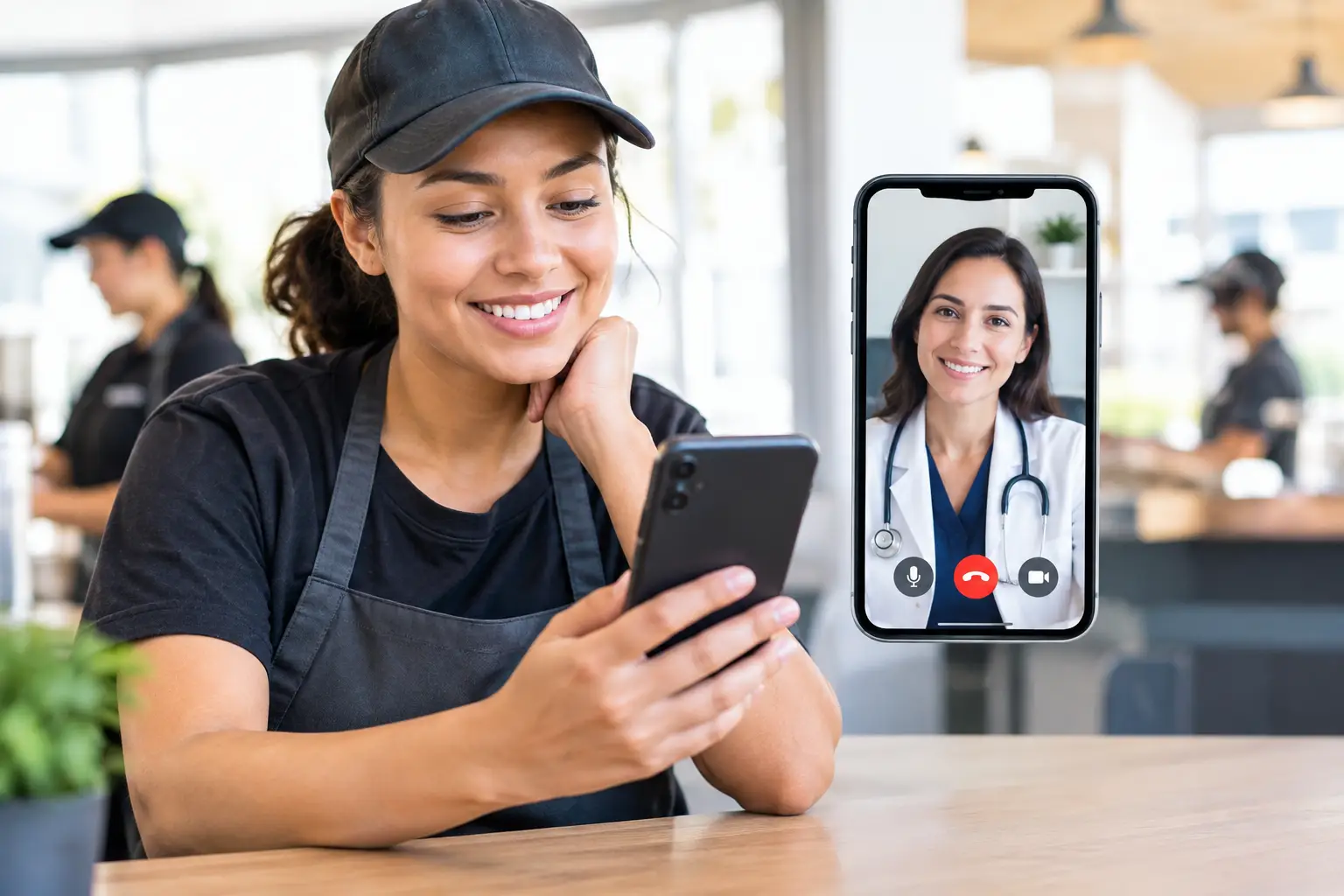
The category deserves careful scrutiny because the label can cover very different offerings. Some products are primarily telehealth services. Others center on discount programs or navigation. A useful healthcare access platform brings several forms of help together: a way to speak with a clinician, assistance finding and using care, prescription savings, support with public-program enrollment when appropriate, and help understanding medical or hospital bills.
The value is in the combination. Unlimited physician access may help an employee decide whether an issue needs urgent attention, routine follow-up, or home care. [Prescription savings](https://ful-health.com/blog/healthcare-guides/how-to-compare-pharmacy-prices-online-and-save) can matter when a medication is affordable at one pharmacy and not another. Enrollment assistance may help an eligible household access coverage it did not know how to obtain. [Hospital-bill support](https://ful-health.com/blog/healthcare-guides/how-to-read-hospital-bills) can be meaningful when a frightening envelope arrives and the employee does not know which questions to ask.
Household access also changes the calculation. Frontline employees do not experience healthcare as individuals separated from their families. A parent worried about a child’s fever, a spouse trying to refill a prescription, or a family facing a billing dispute affects the employee’s day regardless of whose name appears on the schedule.
None of these services makes a high-cost medical event disappear. They are not a substitute for comprehensive insurance, and an operator should be skeptical of any provider that blurs that line. The more practical claim is that healthcare access can be improved before, during, and after common points of confusion and cost.
## Why the economics look different now
Traditional group insurance carries substantial value for employees who are eligible and enrolled. It also carries premiums, plan administration, compliance considerations, participation requirements, and open-enrollment cycles. Those structures are understandable for comprehensive coverage. They are often difficult to extend broadly to a workforce where many employees work variable hours or do not meet eligibility thresholds.
Healthcare access platforms operate on a different cost structure because they are not insurance. The employer is not trying to recreate a medical plan for every employee. The employer is funding a practical layer of care access and support that can be offered more broadly.
That distinction changes the financial conversation. Rather than asking whether the company can afford full insurance for every part-time employee, an operator can ask what it would cost to provide useful healthcare support to the people who otherwise receive little or none through work.
For example, Ful.Health starts at $8.95 per employee per month and includes $0 physician access, prescription savings, healthcare guidance, public-program enrollment assistance, hospital-bill support, and household access. The precise fit will depend on workforce size, employee mix, and how the program is structured. Still, the starting point is materially different from the cost and administrative model of comprehensive insurance.
For a CFO, that makes the investment easier to frame. It is a defined monthly cost, not an attempt to absorb insurance-level expense for every role. For a COO, it can be offered across locations and job types without creating one healthcare experience for salaried leaders and another in which hourly employees are left entirely on their own. For a CEO or owner, it creates a more credible answer to a basic employment question: what does this company offer the people who do much of its essential work?
## The operational case should be tested, not assumed
Healthcare access is worth considering first because employees and households can use it. The business case may follow, but it should not be exaggerated.
Restaurant operators know that replacing employees has costs beyond recruiting spend. There is training time, inconsistent execution during the learning curve, added pressure on experienced team members, and the difficulty of maintaining service standards when staffing changes repeatedly. Better healthcare access could contribute to a stronger employment offer and may be valued by employees who have had little support of this kind. It cannot, by itself, resolve pay concerns, scheduling practices, management quality, or the many reasons people choose to leave a job.
The disciplined approach is to treat the platform as an investment with hypotheses to test. Will employees understand what is available? Will they use it? Does household access increase perceived value? Can location leaders explain it without creating another administrative burden? Are there patterns in employee feedback that suggest the service is addressing real needs?
Those questions matter more than broad promises about retention or absenteeism. A platform that nobody understands is cheap only in the narrowest accounting sense. A platform employees can use when they face a real healthcare problem has a clearer chance of becoming part of the employment value proposition.
## What to evaluate before choosing a platform
The first issue is scope. Ask what happens when an employee needs care, a prescription, help enrolling in available coverage, or support with a confusing bill. A narrow service can still be worthwhile, but its limitations should be explicit.
Next, examine access. Is physician access truly available without a visit fee? Are employees able to use the service outside standard office hours? Can household members participate? Restaurants employ people across varied schedules, and a benefit that is difficult to reach during the hours employees need it is less useful than it looks in a presentation.
Implementation deserves equal attention. The best programs do not require managers to become healthcare experts. Employees need clear, plain-language communication and a simple way to start using the service. The organization needs reliable enrollment processes, straightforward billing, and a partner that can explain what the platform is and is not.
Finally, be precise about claims. If a provider describes itself as insurance when it is not, or implies that virtual physician access replaces emergency or ongoing specialty care, that is a concern. Credibility comes from being clear about the gap the platform can address and candid about what remains outside its scope.
## A broader definition of a competitive employment offer
Restaurants have always competed for people with more than hourly wages. The offer includes schedule quality, team culture, growth opportunity, predictability, and whether employees believe the company sees the pressures of their lives outside work. Healthcare belongs in that conversation, especially for workers who have historically been excluded from meaningful employer support.
The useful shift is not to treat employee healthcare platforms as a perk layered onto the business. It is to recognize that an affordable form of healthcare access may now be available where traditional insurance was not economically workable. That gives operators another legitimate choice between doing nothing and taking on insurance-level cost.
The question is no longer simply who qualifies for the health plan. It is whether the people keeping the restaurant open have a practical place to turn when healthcare becomes difficult to manage.
## Keep Reading
[](https://ful-health.com/blog/workforce-insights/health-insurance-alternatives-for-employees)
### [Health Insurance Alternatives for Employees](https://ful-health.com/blog/workforce-insights/health-insurance-alternatives-for-employees)
The hiring conversation at a restaurant often reaches the same hard edge: the candidate wants to...
[](https://ful-health.com/blog/workforce-insights/healthcare-for-part-time-employees)
### [Healthcare for Part-Time Employees Can Be Practical](https://ful-health.com/blog/workforce-insights/healthcare-for-part-time-employees)
Saturday dinner service rarely exposes a restaurant’s benefit design. The line is moving, the...
[](https://ful-health.com/blog/workforce-insights/workforce-stability-strategy-builds-capacity)
### [A Workforce Stability Strategy That Builds Capacity](https://ful-health.com/blog/workforce-insights/workforce-stability-strategy-builds-capacity)
A schedule can look fully staffed on Friday afternoon and still leave the restaurant exposed by...
Ready to talk?
[Schedule a Conversation →](https://landing.ful-health.com/schedule-a-conversation)
[Contact](https://ful-health.com/contact-us)
©2026 ful.Health LLC All rights reserved.
[Privacy Policy](https://ful-health.com/legal/privacy-policy) [Terms of Service](https://ful-health.com/legal/terms-of-service)
```json
{
"@context" : "https://schema.org",
"@type" : "BlogPosting",
"author" : {
"@type" : "Person",
"name" : "Carrie Tedore",
"url" : "https://ful-health.com/blog/workforce-insights/author/carrie-tedore"
},
"datePublished" : "2026-09-11T02:18:31.000Z",
"headline" : "What Employee Healthcare Platforms Change",
"image" : [ "https://afocirmbqdxnkyescnev.supabase.co/storage/v1/object/public/featured-images/890b153f-86f0-41a5-98f8-a16f8ab177a6/workflows/ae5af564-11cf-45f7-9d2c-851dfdc5844a.webp" ],
"mainEntityOfPage" : {
"@id" : "https://ful-health.com/blog/workforce-insights/what-employee-healthcare-platforms-change",
"@type" : "WebPage"
},
"publisher" : {
"@type" : "Organization",
"logo" : {
"@type" : "ImageObject",
"url" : "https://ful-health.com/hubfs/ful%20logo_full%20color_RGB.png"
},
"name" : "ful.Health LLC"
}
}
```